Training institutes teach a skill rather than a school syllabus: computer courses and programming, typing and stenography, accounting software, beauty and wellness, tailoring, nursing and paramedical assistance. Students join for a few months, pay fees in instalments and leave with a letter or certificate they will show employers — so the institute’s letterhead travels further than it seems.
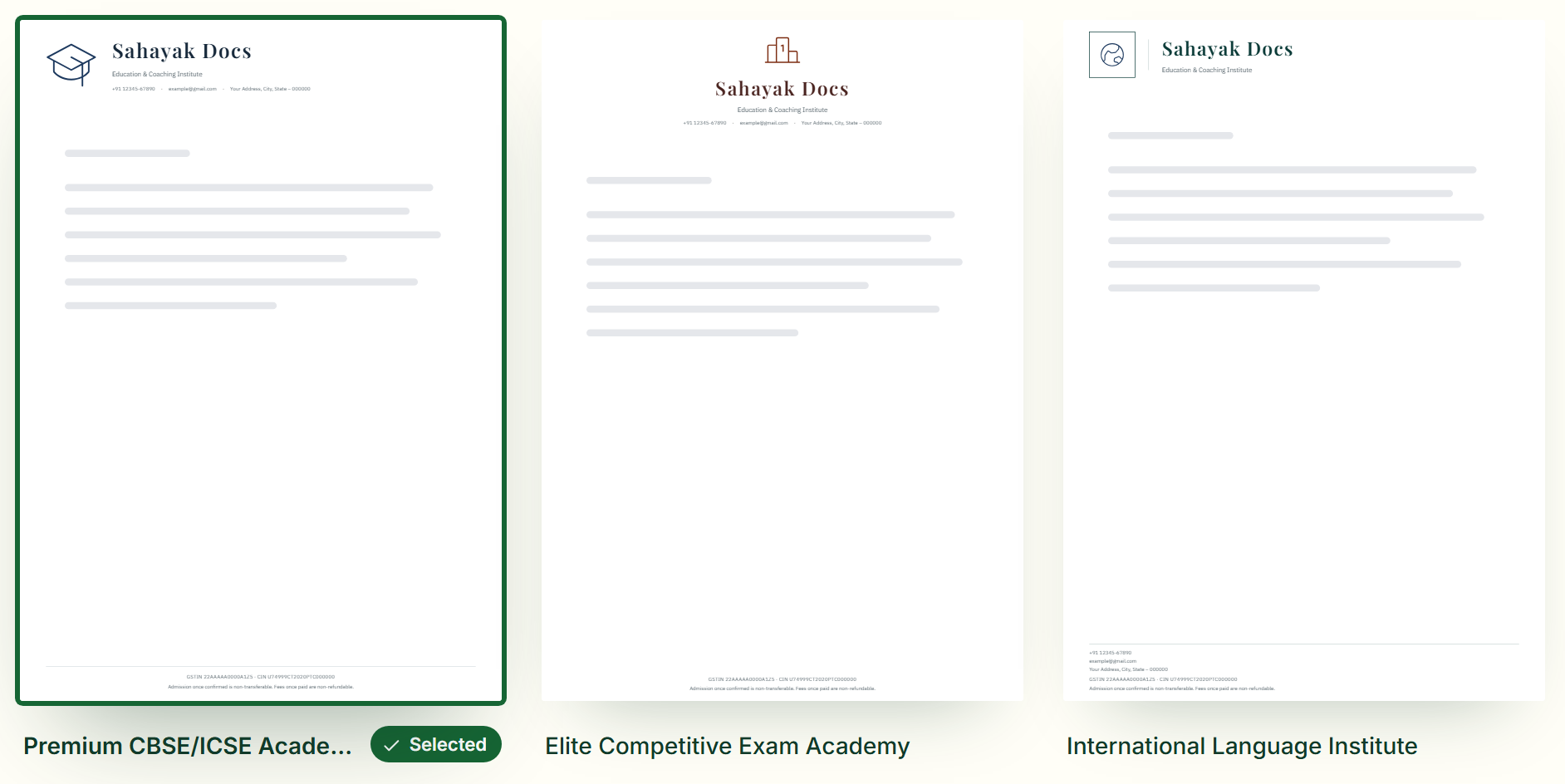
What a training institute letterhead should show
- Institute name and logo, with your main courses in the tagline
- How you are registered — as a society, trust, company or under Udyam — and the number
- Affiliations, recognitions or franchise names, only if they are current and genuine
- Courses offered, listed in the services line
- Address, phone, email and batch timings
- Director’s or centre head’s name in the footer
Letters you’ll send
- Admission letters with course, batch and fee details
- Fee receipts for each instalment
- Course completion letters
- Internship and placement assistance letters
- Notices about batches, exams and holidays
What a course completion letter says
- Student’s name and enrolment number
- Course name and duration, with start and end dates
- Result or grade, if there was an assessment
- Reference number and date of issue
- Signature of the director or centre head
Certificate, diploma — never “degree”
Whatever your course completion letter calls what a student earns, be careful with one specific word: “degree”. Under Sections 22 and 23 of the UGC Act, 1956, only a university set up by a central or state Act, or an institution deemed a university under Section 3, may confer a degree or use the word “University” in its name — a private skill or computer institute can’t, no matter how long or thorough its course is. The UGC periodically publishes and updates a list of “fake” or “self-styled” universities it has identified for exactly this kind of overreach, and a qualification from one of them isn’t recognised anywhere. “Diploma”, “Certificate” and “Certificate of Completion” are all safe, accurate words for what a training institute issues; “Degree” and “University” are not, however impressive the course sounds, and using them without the right recognition is the kind of letterhead detail that can cause real trouble for a student down the line, not just the institute.
Coaching for school subjects and competitive exams has its own page, the coaching institute letterhead, and schools have theirs. This page is for skill and vocational training.
Employers may call to check a completion letter. Print a phone number that is answered during working hours, and keep a register of every letter you issue.
Why Sahayak Docs
- Free — every design and download, no sign-up, watermark optional
- Ready-made designs for your industry, editable down to every element
- PDF letter pads in A4, A5, A3, Letter and Legal, plus header & footer PNGs
- Works in the browser on computer, tablet and phone
Frequently asked questions
Can I mention a university or board affiliation on the letterhead?
Only if your institute holds that affiliation now, in writing. Printing an affiliation you don’t have misleads students and can lead to legal trouble, so list only the recognitions you can prove.
Is this suitable for a franchise centre?
Yes. Show your centre’s own name and address, and the franchisor’s name only in the way they permit — many franchisors have their own rules for using their name and logo.
See education designsor read: How to make a professional letterhead (step by step)