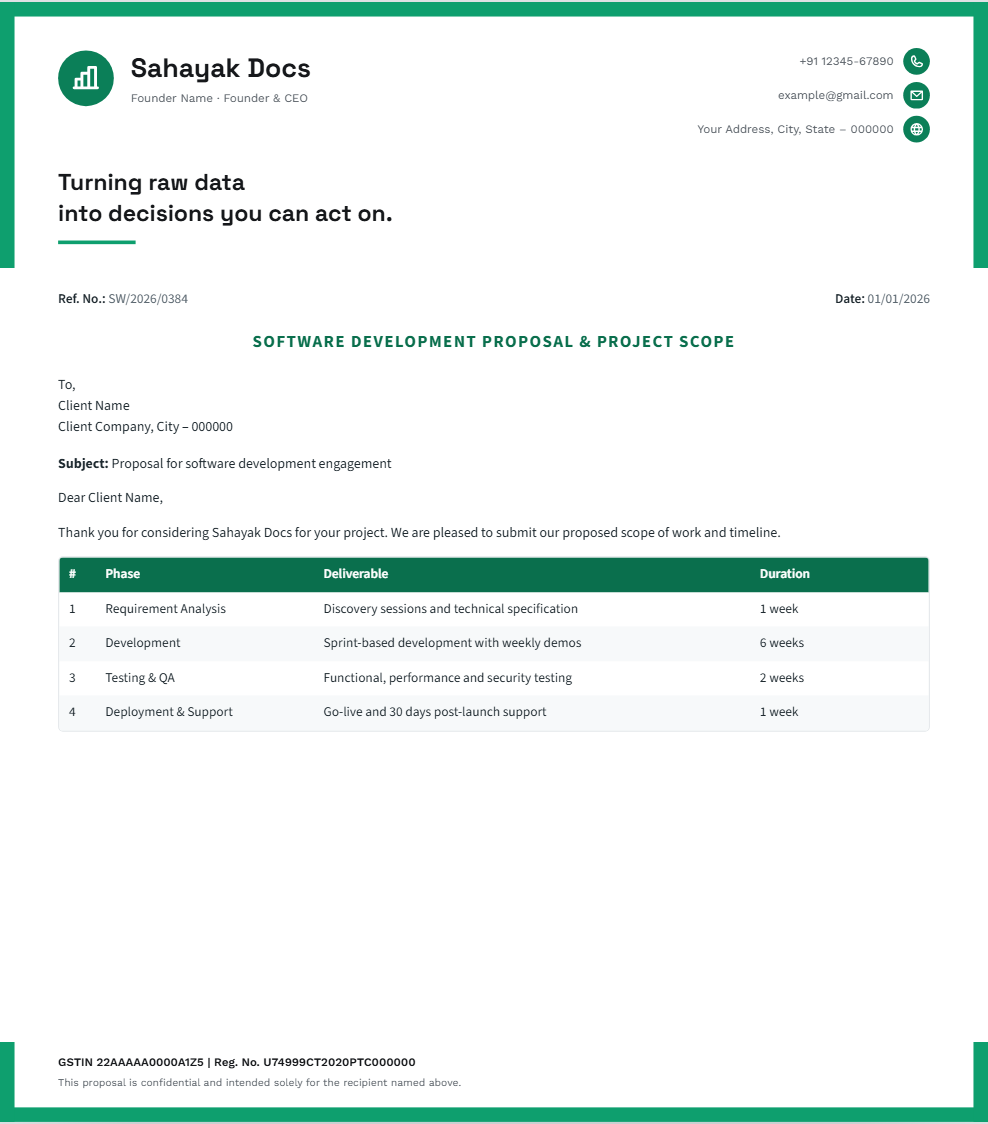
A Private Limited company’s letterhead isn’t only a branding choice — Section 12(3) of the Companies Act, 2013 sets out specific information every company must print on its business letters, billheads, letter papers and official notices. Get this wrong and it’s a compliance gap, not just a design one.
What Section 12(3) actually requires
- The company’s full registered name, exactly as it appears on the Certificate of Incorporation — including the “Private Limited” suffix
- Corporate Identity Number (CIN) — the 21-character number issued by the Registrar of Companies
- The registered office address, as filed with the RoC (not a branch or correspondence address, unless shown separately and clearly labelled)
- Telephone number, email address and website, if the company has them
GSTIN isn’t a Companies Act requirement, but it is a GST requirement on tax invoices, and most companies show it on general letterhead too, since it’s one of the first things a vendor or customer looks for.
Good practice, but not legally required
- Logo and tagline
- Bank account details for invoices
- Authorised signatory’s name and designation in the footer
- Social profiles or a website link
Private Limited vs LLP vs OPC vs partnership firm
| Entity type | Identifier on the letterhead | Example format |
|---|---|---|
| Private Limited company | CIN (21 characters) | U00000CT2020PTC000000 |
| One Person Company (OPC) | CIN, and “(OPC) Private Limited” as part of the name itself | U00000CT2020OPC000000 |
| LLP | LLPIN (7 characters) instead of a CIN | AAA-1234 |
| Partnership firm | No CIN — show the firm’s PAN, and GSTIN if registered | — |
The OPC rule surprises most founders: it isn’t a person’s name that has to appear below the company’s name — it’s the words “(OPC) Private Limited”, as part of the registered name itself, wherever that name is printed, affixed or engraved (letterhead, nameplate, invoices, notices), not only on the incorporation certificate. Where the OPC’s name changes, the former name stays on the letterhead for two years from the change, per the general rule below.
That general rule — Section 12(3), proviso — applies to every company, not only OPCs: if a company has changed its name within the last two years, it must print the former name alongside the current one, labelled “formerly”, on every letterhead, billhead and official notice until the two years are up.
Where these usually sit on the page
Most companies keep the name and logo prominent in the header, and move the registered office address, CIN and GSTIN into the footer as smaller print — they need to be present and accurate, not large. Phone and email can sit in either place depending on how much room the header has.
If your registered office address changes, update your letterhead the same week you file the RoC change — an outdated address on a business letter is a compliance mismatch, not just a stale-looking design.
For the exact fields a GST tax invoice itself needs (as opposed to general letterhead), see our guide on using a letterhead for GST invoices and quotations.
Frequently asked questions
Is a logo legally required on a company letterhead?
No — the Companies Act requires the name, CIN, registered office and contact details (where they exist); a logo is a branding choice, not a compliance one.
Do private limited companies need to show GSTIN on every letter?
GSTIN is a GST requirement for tax invoices specifically. It isn’t mandated by the Companies Act for general correspondence, but most companies include it anyway since customers and vendors look for it.
What changes for a One Person Company?
The registered name itself must include “(OPC) Private Limited”, and that full name — not a person’s name — is what has to appear on the letterhead itself, not just in the incorporation paperwork.