These four documents get confused constantly, partly because a proforma invoice is deliberately designed to look almost identical to a real one. Mixing them up isn’t just a formatting slip — a proforma invoice has no tax validity, and using the wrong document can cost a customer their input tax credit.
The four documents, compared
| Document | Sent by | When | Legal / tax standing |
|---|---|---|---|
| Quotation | Seller | Before a sale, to offer a price | Not a tax document — label it clearly and add a validity date |
| Proforma invoice | Seller | Before a sale — for an advance payment request, an import/export declaration, or to show the buyer what the final invoice will look like | Looks like an invoice but has no tax validity — the buyer cannot claim input tax credit on it |
| Tax invoice | Seller | At the time of an actual supply of goods or services | The legally valid GST document — see our GST invoice guide for the exact fields it needs |
| Purchase order (PO) | Buyer | To confirm they want to buy, at an agreed price and terms | Not a tax document — its PO number should be referenced on the seller’s invoice so both sides match |
Why the proforma invoice causes the most confusion
A proforma invoice is built to look like the real thing — same layout, same line items, often the same letterhead — which is exactly why it needs to be unmistakably labelled. Print “PROFORMA INVOICE — NOT A TAX INVOICE” clearly on it, and don’t reuse your tax invoice’s numbering sequence for proforma copies; keep them visually and numerically distinct.
The numbering rule most small businesses miss
Under GST invoice rules, a tax invoice must carry a consecutive serial number that is unique for a financial year — not just “unique”, but genuinely sequential, with no gaps or reused numbers. A quotation or proforma invoice doesn’t have to follow this rule, which is one more reason to keep their numbering visually separate from your actual tax invoice sequence.
When a small shop can skip the formal tax invoice
A shop below the GST registration threshold (₹40 lakh for most goods, ₹20 lakh for services, with lower limits in some states) can run on a simple cash memo rather than a formal GST tax invoice. The moment you register for GST, your invoices need the full set of required fields — see our shop letterhead and GST invoice guides for what changes.
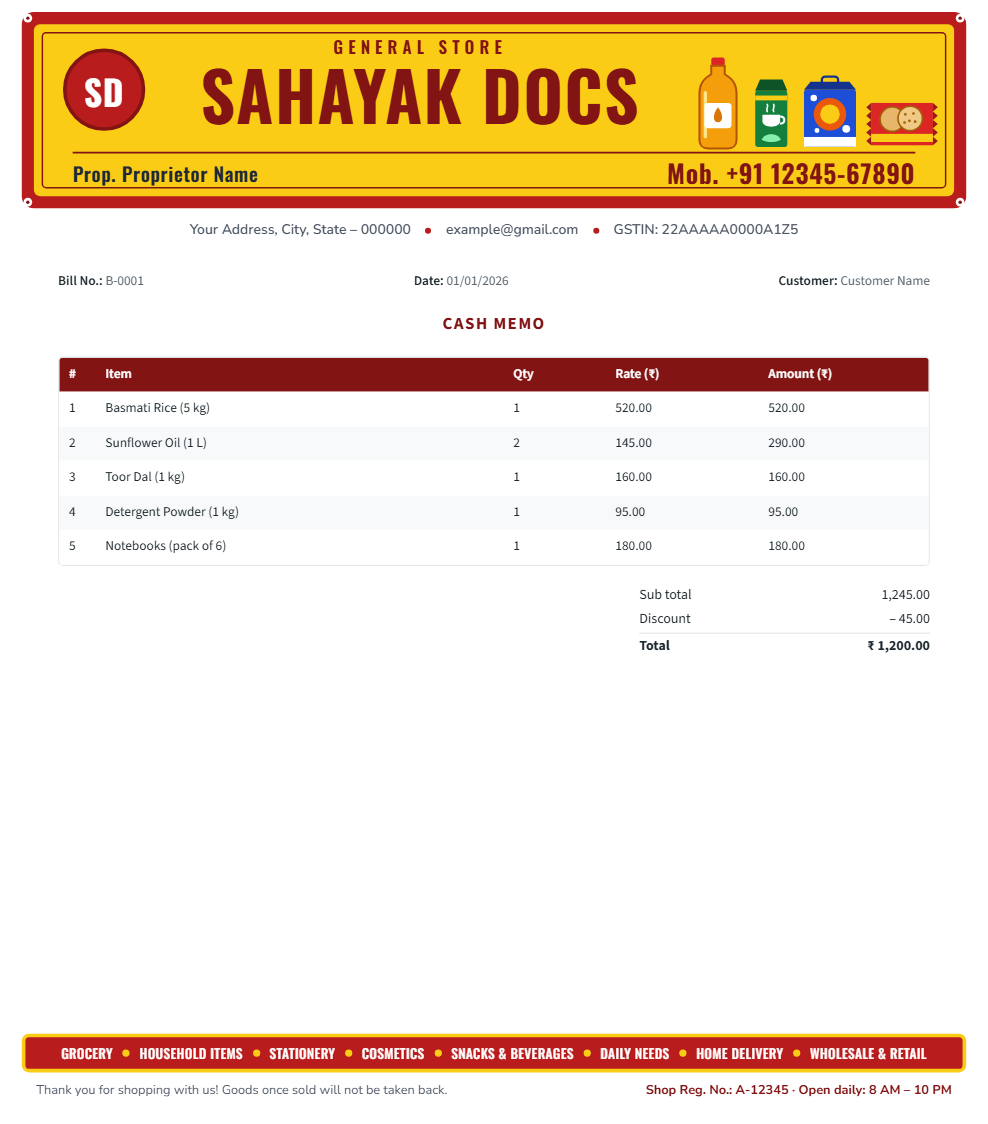
Keep quotations, proforma invoices and tax invoices as visually distinct document types on the same letterhead — a type badge or heading (QUOTATION, PROFORMA INVOICE, TAX INVOICE) removes any doubt about which one a reader is holding.
Frequently asked questions
Can a customer use a proforma invoice to claim input tax credit?
No — a proforma invoice has no tax validity. Input tax credit can only be claimed against a proper tax invoice.
Does a quotation need a GSTIN?
It isn’t required the way it is on a tax invoice, but showing it is good practice — it signals you’re GST-registered before the customer even asks.
Can I use one letterhead for all four document types?
Yes — the same design works for all of them. What changes is the heading or type badge, the numbering sequence, and which fields the document legally needs to carry.