A school’s letterhead travels further than most. A bonafide certificate goes to a bank or a passport office, a character certificate to another school, a circular home in every child’s bag. Each is read by someone checking that the school is real and recognised, so the board, affiliation number and UDISE+ code belong on the page, not just the name and address.
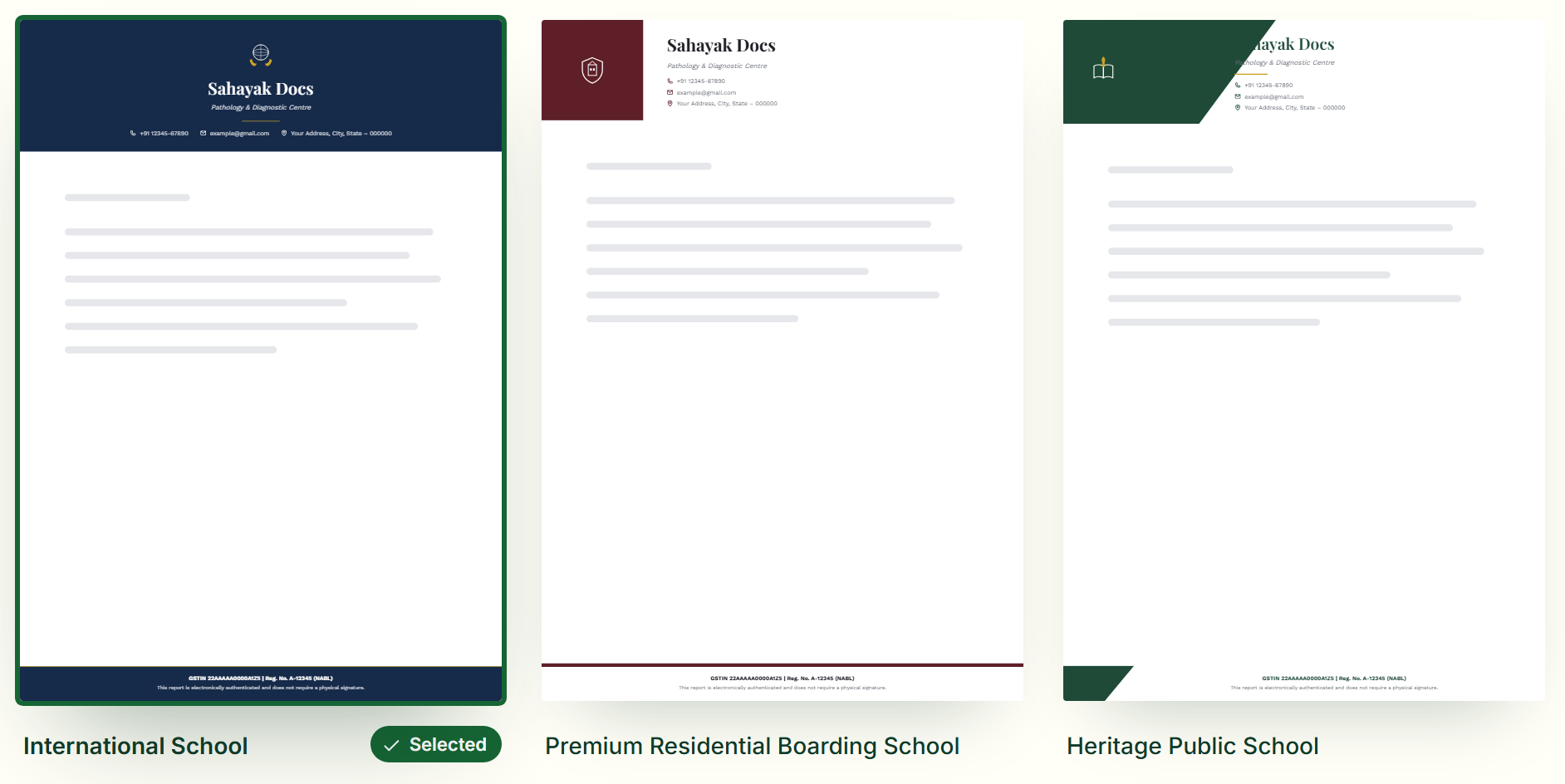
What a school letterhead should show
- School name and logo, with the medium or level if useful (for example “English Medium Senior Secondary School”)
- Board and affiliation details — for a CBSE school, the affiliation number and school code; for a state-board school, its recognition number
- UDISE+ code, the number every recognised school has in the national school database
- Full address with PIN code, office phone, email and website
- Principal’s name in the footer, above the signature space
- Office hours for parents, if you want fewer calls outside them
Recognition isn’t optional paperwork
Section 18 of the Right to Education Act, 2009 bars any school other than one run by the government or a local authority from operating without a certificate of recognition from the prescribed authority — continuing to run without one, or after recognition is withdrawn, carries a fine of up to ₹1 lakh plus ₹10,000 for every day the school keeps operating. That certificate, tied to meeting the norms set out in the Act’s Schedule — teachers, classrooms, toilets, drinking water, a library — is what your board affiliation or recognition number on the letterhead stands for, not just a line to fill in.
Letters a school sends on its letterhead
- Circulars and notices to parents — holidays, exams, fee dates, events
- Bonafide and character certificates for students
- Transfer certificates, where the school issues them on its own pad rather than through a state portal
- Letters to the board, the education department or the district education office
- Permission letters for trips, sports meets and inter-school events
Give every certificate a number
Banks, embassies and other schools often phone a school to confirm a certificate before accepting it. Write an outward reference number and the date on every certificate you issue, and keep a register of them — those calls become quick to answer, and a forged certificate becomes easy to spot.
Download the same design as an A4 pad for certificates and letters, and as an A5 pad for short circulars — half the paper for a notice that only needs a few lines.
Why Sahayak Docs
- Free — every design and download, no sign-up, watermark optional
- Ready-made designs for your industry, editable down to every element
- PDF letter pads in A4, A5, A3, Letter and Legal, plus header & footer PNGs
- Works in the browser on computer, tablet and phone
Frequently asked questions
What is the UDISE+ code, and should it be on the letterhead?
UDISE+ is the Ministry of Education’s national database of schools, and every recognised school has a UDISE+ code. Printing it next to your affiliation or recognition number helps anyone checking a certificate confirm the school is genuine.
Do we need a new design when the principal changes?
No. The principal’s name sits in an editable field, so you change the name and download the letterhead again.
Can a school with two branches use one design?
Yes — download it once per branch with that branch’s address and phone, so each campus has its own pad in the same style.
See education & coaching designsor read: How to make a professional letterhead (step by step)