A place of worship writes more letters than people expect: festival invitations to the whole neighbourhood, notices to members, acknowledgements to donors, and requests to the police or municipal office for processions, gatherings and events. A letterhead with the registered name, address and office-bearers makes each of those letters as considered as the institution sending it.
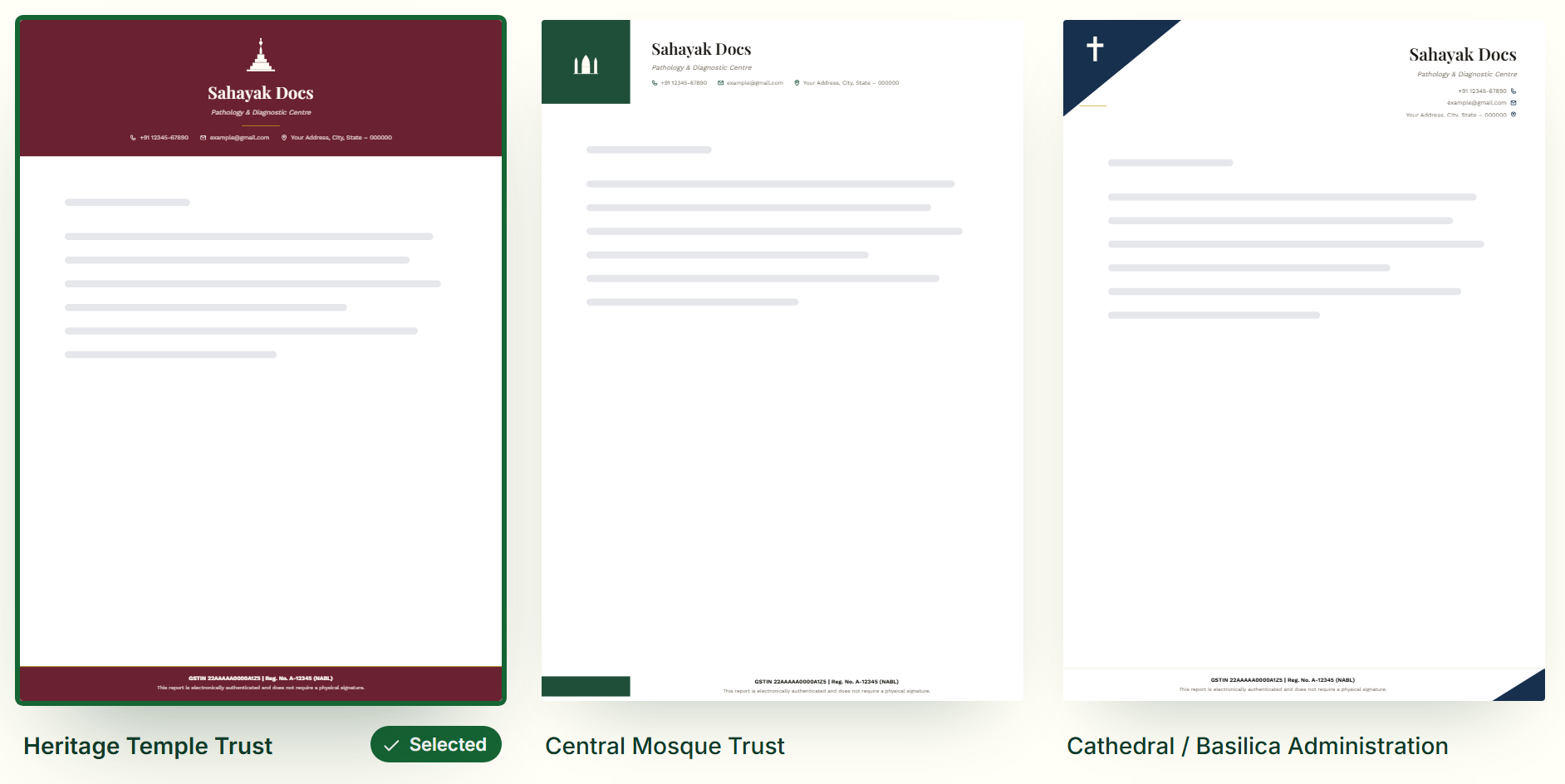
What a place of worship’s letterhead should show
- Name of the temple, church, mosque or gurudwara, with the locality
- The body that manages it — trust, society, waqf or board — and its registration number
- Office address, phone and email
- Office-bearers in the footer: president, secretary and treasurer, or the priest, pastor, imam or granthi where they sign letters
- An 80G number, only if the managing body actually holds 80G registration
- Your own emblem or symbol, if you use one
Which law covers your institution differs by faith
A mosque or dargah’s waqf is registered under one central law, the Waqf Act, 1995, with the State Waqf Board — the same rule applies wherever the mosque is. A temple is different: it follows its own state’s law where one exists (Tamil Nadu, Andhra Pradesh, Karnataka and Odisha each run their own Hindu Religious and Charitable Endowments Act, with different registration and oversight), and in states without such an Act a temple registers like any other public trust. Gurudwaras mostly follow that same trust-or-society route too — only a specific list of historic gurdwaras, mostly in Punjab, Haryana and Chandigarh, fall under the separate Sikh Gurdwaras Act, 1925 and answer to the SGPC. Put the body and the law that actually applies to you on the letterhead, not whichever sounds most official.
Letters and documents it is used for
- Festival and event invitations
- Notices to devotees and members — timings, services, meetings
- Acknowledgements to donors (donation receipts are covered on the NGO & association page)
- Letters to the police or municipal office seeking permission for processions or events
- Letters to members of the managing body
Writing to the police or municipal office
Permission requests for a procession, a gathering or loudspeakers at an event are read by officers who need specifics. State the date, timings, route or venue, expected attendance, and the name and phone number of the person responsible, and have an office-bearer sign it. A vague request usually comes back with questions.
Put prayer or service timings in the footer of notices to devotees — it answers the most common question before anyone has to phone.
Why Sahayak Docs
- Free — every design and download, no sign-up, watermark optional
- Ready-made designs for your industry, editable down to every element
- PDF letter pads in A4, A5, A3, Letter and Legal, plus header & footer PNGs
- Works in the browser on computer, tablet and phone
Frequently asked questions
Can we show our 80G number on the letterhead?
Only if the managing body actually holds 80G registration. Donors use the number to claim a tax deduction, so it must match your current registration certificate.
Who should sign letters from a place of worship?
Usually the office-bearer the managing body’s rules authorise, often the secretary or president. Print their designation in the footer so every letter shows who it is from.
Do you have examples for temples, churches, mosques or gurudwaras?
Yes — see "Letterhead examples with logo" for real examples across every category, including places of worship, with your own name and emblem in place as soon as you open one.
See NGO & association designsor read: How to make a professional letterhead (step by step)