A firm’s letterhead says more than its name. A proprietor signs as “Prop.”, a partnership often lists its partners, and an LLP or a company has details the law requires on its business letters. Getting these right makes quotations, bank letters and government correspondence easier to accept, and saves a reprint when someone asks for the missing number.
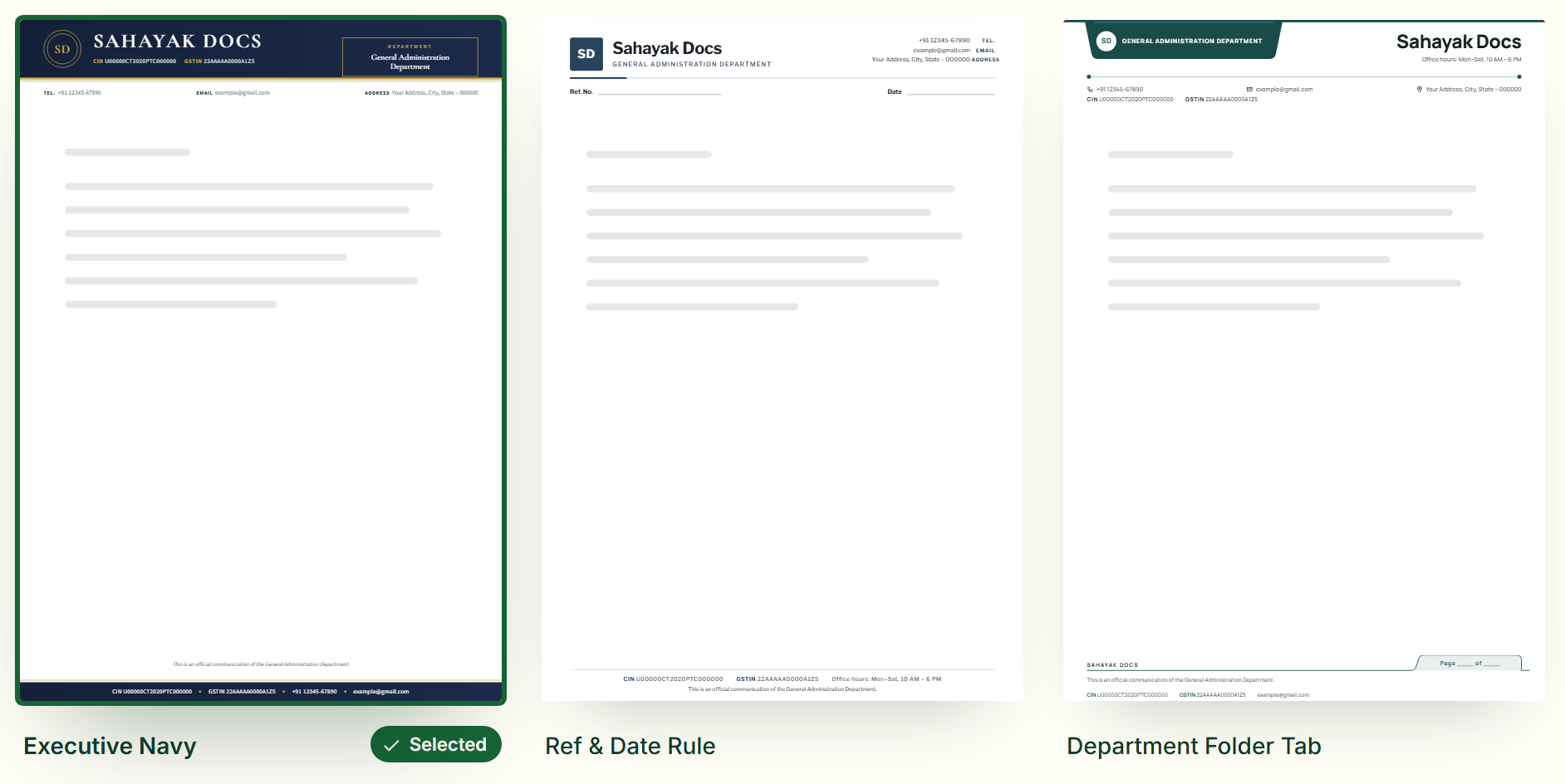
What each business type usually prints
| Business type | Usually printed on the letterhead |
|---|---|
| Proprietorship | Trade name; “Prop.” with the owner’s name; address and contact details; GSTIN if registered; Udyam number (optional) |
| Partnership firm | Firm name; partners’ names; firm registration number if registered with the Registrar of Firms; GSTIN if registered |
| LLP | Name ending in “LLP”; registered office address; LLPIN; a statement that it is registered with limited liability — the LLP Act, 2008 requires these on invoices and official correspondence |
| Private limited company | Name; registered office address; CIN; phone number, plus email and website if any — Section 12 of the Companies Act, 2013 requires these on business letters and letter papers |
| One Person Company | Everything a private limited company prints, plus “(One Person Company)” below the name |
Why an unregistered partnership firm should care
Registering a partnership firm with the Registrar of Firms is optional under the Partnership Act, 1932 — but Section 69 of the Act makes that choice matter: an unregistered firm can’t go to civil court to enforce a contract against a third party, or sue a partner over a dispute with the firm. A registration number printed on the letterhead is the easiest, most visible proof you’ve covered that gap.
Laying out the details
- Lead with the trade or firm name your customers know; the proprietor’s or partners’ names can sit in a smaller line below it or in the footer.
- Keep registration numbers — GSTIN, LLPIN, CIN, Udyam — together, usually in the footer, so they are easy to find and copy.
- Use the registered office address where the law asks for it, and add a branch or works address separately if letters come from there.
Want to browse layouts first? The company & business letterhead page shows the designs for companies and their departments, and the guide on what to include on a business letterhead covers contact lines and tax numbers in more depth.
Changed your business structure — say a proprietorship became an LLP? Make a new letterhead with the new name and numbers straight away, and stop using the old stock.
Why Sahayak Docs
- Free — every design and download, no sign-up, watermark optional
- Ready-made designs for your industry, editable down to every element
- PDF letter pads in A4, A5, A3, Letter and Legal, plus header & footer PNGs
- Works in the browser on computer, tablet and phone
Frequently asked questions
Does a proprietorship need a registration number on its letterhead?
No law requires one, but a GSTIN (if you are GST-registered) or an Udyam number makes the business easier to verify. Add whichever you have in the registration and GSTIN fields.
Should a partnership letterhead list all the partners?
Many do, especially professional and small firms, because clients and banks like to see who stands behind the business. It isn’t a legal requirement; a firm with many partners can list just the managing partners.
What must an LLP print on its letterhead?
Its name, registered office address and LLPIN, plus a statement that it is registered with limited liability — the LLP Act, 2008 requires these on official correspondence. Adding your GSTIN, phone and email is common practice.
See company & office designsor read: What to include on a business letterhead in India